MPC Wallets for Teams: Stop Running a Rescue Operation
MPC Wallets for Teams: Stop Running a Rescue Operation

Month-end closes in 3 hours. Finance needs proof that five payouts from last quarter actually happened—with approvals, policy refs, the works. You've got partial CSVs, a Slack thread, and someone's memory that "Dave approved it on his phone."
Nothing broke on-chain. What's missing is evidence people can trust.
Here's the trap: USDT on Ethereum is not USDT on Tron. Different contract, different fees, different address format. One stale label or free-typed address and your routine vendor payout becomes a three-day reconciliation job.
Now picture this: A payout gets requested. Approver checks a whitelist, taps a memo, confirms on mobile. Receipt lands instantly with policy name, approver ID, contract address, on-chain hash. No Slack archaeology. No screenshots.
If your auditor pulled random transactions right now, could you prove each one in under sixty seconds?
The fix is boring in the best way. Treat the receipt as the actual product. Use policy to run approvals. Let an MPC wallet handle shared control. Keep destinations in an address book mapped to contract IDs. Multi-chain stops feeling like a cage match.
Multi-Chain Wallet Management: Treat Chains as Surfaces
Your trader tops up a market maker account on Ethereum before lunch. Your vendor asks for USDT on Tron after. Both say "USDT" in chat. They mean completely different things.

If the mapping lives in someone's head or buried in message threads, mistakes follow.
Here's what works: Treat every chain as an interchangeable surface under one control layer. The human parts stay constant. Roles, permissions, policies—you define them once. One address book. Labels map to contract IDs per chain. One receipt format: initiator, approver, policy reference, on-chain hash.
Quick scenario. Your desk lead is in an Uber, heading to a client meeting. Approval requests hit their phone. Policy checks the amount, confirms business hours, requires a memo. They tap approve. The same flow works on ETH, BSC, Base, Tron. Control doesn't change when the chain does.
MPC Wallet Security: Shared Custody That Scales With Your Team
Solo key custody breaks the second your team grows. MPC wallets split key shares across devices and people. Signing only happens when the right roles approve. Quorum becomes an output of policy, not a hardcoded signer list.
Start simple: two people, joint control.
Single point of failure—gone.
Natural review barrier for risky moves—installed.
Scale it. Add requestors, reviewers, approvers, auditors. New payees get dual review. Address labels carry contract IDs per chain so nobody's free-typing addresses or mixing up tickers. Checksum validation on EVM catches typos. Tron format checks do the same [4].
Scenario: Your ops person enters a new BSC vendor address. One character is wrong. Checksum fails. Policy requires dual review for new payees anyway. The reviewer rejects it, fixes the label with the correct contract. Next attempt passes. Funds don't move until the whitelist is clean.
Policy-Based Approvals: Mobile-First Workflows for Crypto Operations
Policy-based approvals turn judgment calls into predictable flows. Good policy is short, human-readable, and testable. Your approver should be able to decide in seconds with full context on a phone screen.
Trader top-ups
Per-transaction caps. Daily limits. Desk leads approve small amounts on mobile. Finance approves larger ones. Business-hours only. Destinations locked to whitelisted market maker accounts.
Vendor payouts
Default to BSC or Tron—fees stay predictable. Ethereum only when the vendor requires it. Bind policy to contract IDs, not ticker symbols. Same ticker doesn't mean same asset across chains. USDC support on Tron ended in 2024—this is exactly why contract ID rules beat symbol rules [1].
Treasury moves
Weekly caps. Fee ceilings on Ethereum. Destinations restricted to cold storage and market maker wallets. Schedule windows for large transfers so your approvers are awake and fee conditions are reasonable. On Base, fees include L2 execution plus L1 security components—another reason for timing and ceilings on big moves [5].
Bridges? Make them the exception.
Keep them off by default. When you absolutely need to move liquidity, require a reason code and capture both transaction hashes on the receipt. Bridge exploits have torched millions in recent years. Extra approvals and full receipts shrink the blast radius when something goes sideways [3].
Crypto Audit Trails: Building Compliance-Ready Transaction Receipts
Audit trails aren't dashboards but evidence.
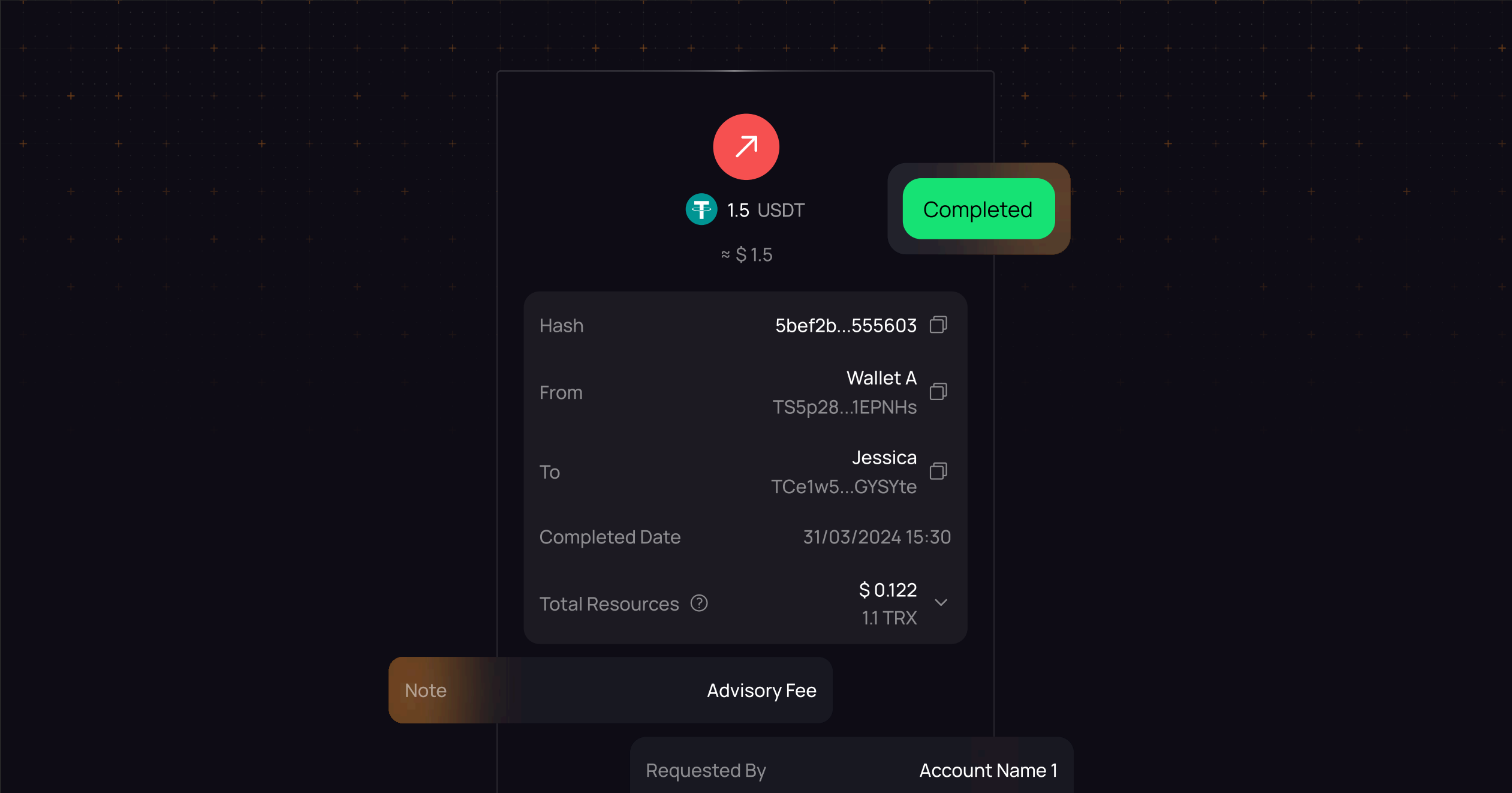
A real receipt ties people, policy, and chain data into one line of truth that finance can consume without a scavenger hunt. Should look identical whether it's ETH, BSC, Base, or Tron.
Every receipt needs:
- Initiator ID, timestamp, memo
- Approver ID or quorum, policy name and version
- Asset, chain, exact contract address, correct decimals
- Destination label from address book plus raw address
- Amount, fee amount, fee asset
- On-chain transaction hash, explorer link
This structure maps cleanly to ledgers and disclosures. Policies map to GL accounts. Stablecoin decimals and contract IDs prevent symbol mix-ups across chains. Fees live in their own field so FX and tax logic stays consistent. Finance gets what they need under evolving accounting guidance for crypto without reconstructing events from screenshots three months later [2].
Quick test: Pick any receipt. Link it to the relevant ledger entry in under sixty seconds. If you can't, the receipt is missing a field finance needs.
Crypto Operations Monitoring: Weekly Review for Risk Management
Thirty minutes a week keeps you ahead of risk.
Review the signals that matter. Tune policy, addresses, schedules accordingly.
Weekly checklist:
- Exceptions: Overrides, denied destinations, after-hours attempts
- Policy coverage: Share of volume that matched policy without manual work
- Approval SLA: Median and 95th percentile by desk and chain
- Fee posture: Compare actuals to ceilings on Ethereum; confirm chain preferences on routine payouts; factor in L2 + L1 components where relevant [5]
- Address book hygiene: Validate new entries, archive stale vendors, confirm contract IDs; checksum and format validation block typos [4]
- Bridge audit: If used, verify both hashes plus reason code on receipt [3]
Incidents will happen. Devices get lost. People leave. Fees spike.
Your control layer should absorb the hit without freezing operations. Revoke lost devices, rotate shares. Offboard by removing roles, rotate where needed. When fees surge, shift high-value moves to scheduled windows and preferred chains. For new Tron vendors, require dual review and pass format validation before funds move.
MPC Wallet Implementation: 90-Day Rollout Plan
Leaders want fewer exceptions, faster approvals, clean month-ends.
Simple rollout. Proves value without changing how people work.
Days 1–30
Build address book for USDT and USDC across ETH, BSC, Base, Tron. Ship three core policies. Turn on memos, receipts, standard CSV export. Run tabletop drill: lost device scenario, first vendor payout.
Days 31–60
Wire SDK into OMS or AP so requests start where people work. Add fee guards on Ethereum, chain preferences for payouts. Start weekly review.
Days 61–90
Measure policy coverage, approval SLA, fee variance by chain. Target one-third fewer exceptions, forty percent faster approvals, two-hour crypto close. Keep bridges off by default. If you must bridge, capture both hashes plus reason code.
When the receipt becomes the artefact, coordination stops being fragile. The MPC wallet handles cryptography. Policy-based approvals keep authority clear. Finance trusts the numbers because evidence is captured at approval time, not reconstructed from memory later.
Want help mapping this to your environment? Request an architecture walkthrough or talk to our team.
References
[1] Circle. (2024, February 21). Circle is discontinuing support for USDC on the TRON blockchain. https://www.circle.com/blog/circle-is-discontinuing-support-for-usdc-on-the-tron-blockchain
[2] Financial Accounting Standards Board. (2023). Accounting Standards Update 2023-08—Intangibles—Goodwill and Other—Crypto Assets (Subtopic 350-60): Accounting for and Disclosure of Crypto Assets. https://www.fasb.org/page/Document?pdf=ASU+2023-08.pdf&title=ACCOUNTING+STANDARDS+UPDATE+2023-08%E2%80%94Intangibles%E2%80%94Goodwill+and+Other%E2%80%94Crypto+Assets+%28Subtopic+350-60%29%3A+Accounting+for+and+Disclosure+of+Crypto+Assets
[3] Chainalysis. (2024, December 19). $2.2 billion stolen in crypto in 2024 but hacked volumes fell in H2. https://www.chainalysis.com/blog/crypto-hacking-stolen-funds-2025/
[4]
• Ethereum Foundation. (2016, January 14). EIP-55: Mixed-case checksum address encoding. https://eips.ethereum.org/EIPS/eip-55
• Ethereum Foundation. (2018, March 18). EIP-1191: Add chain ID to mixed-case checksum address encoding. https://eips.ethereum.org/EIPS/eip-1191
• TRON Protocol. (n.d.). Account model: TRON address characteristics (Base58 and hex formats). https://tronprotocol.github.io/documentation-en/mechanism-algorithm/account/
[5] Base. (n.d.). Network fees: L2 execution fee and L1 security fee. https://docs.base.org/base-chain/network-information/network-fees