Tariffs, ETF Swings, and Stablecoin Laws: Everything That Moved Crypto in Q1 2026
Tariffs, ETF Swings, and Stablecoin Laws: Everything That Moved Crypto in Q1 2026

Everyone who called 2026 the year crypto goes mainstream had some explaining to do in Q1.
Bitcoin's worst start on record. Sentiment in freefall. Billions wiping out of ETFs in a matter of weeks. If you had gone public with a bullish January prediction, Q1 made you look foolish.
Good.
Because the real story had nothing to do with the price.
While the charts bled, regulation got signed into law, institutions loaded up quietly, and the infrastructure layer that serious digital asset operations actually need stopped being a niche conversation. Q1 2026 was not a setback for crypto. It was a filter.
Here is what it filtered out — and what it left standing.
Section 1 — The market pulled back, and that was always part of the picture
Bitcoin opened 2026 under pressure. According to CoinDesk, the asset fell 10% in January and a further 15% in February — the first time Bitcoin has ever recorded back-to-back declines in those two months, based on Coinglass data. By the first 50 days, it had logged its worst-ever start to a financial year on record.

By mid-quarter, market sentiment had swung sharply negative, with the Crypto Fear & Greed Index falling to 19 — deep in Extreme Fear territory — according to analysis from Amberdata. The cause was not a single event but a cluster of them arriving at the same time.
Macroeconomic policy uncertainty played the biggest role. The Trump administration's aggressive tariff regime through January pushed global risk assets lower across the board, with crypto absorbing the same pressure as equities. The Yale Budget Lab estimates that the overall average effective tariff rate — even after the Supreme Court's February ruling striking down IEEPA-based tariffs — still sits at its highest level since 1946, excluding 2025. VanEck's research team described the sell-off as "orderly deleveraging rather than capitulation," with leverage normalizing and volatility remaining below prior bear-market levels.
March brought a partial reset. Prices began to stabilize. Sentiment indicators edged back toward neutral. Historically, Extreme Fear readings have marked correction floors more often than the start of prolonged bear runs — and Q1 2026 appeared to follow that pattern.
What this means for operators: market volatility is not going away. But the teams who weathered Q1 without chaos were the ones with consolidated visibility across their wallets and positions — not the ones chasing price action across browser tabs and block explorers. When assets are spread across multiple chains and addresses with no single view of what sits where, every market swing becomes operationally expensive. The answer is not to predict volatility better. It is to see your entire portfolio clearly at all times, so decisions are made from data rather than incomplete pictures.
This is exactly the operational gap that a proper multi-chain digital asset dashboard addresses — tracking positions across chains and wallets in real time, not reconstructing them after the fact.
Section 2 — Institutional money did not leave. It waited, then moved.
The ETF data from Q1 tells a more nuanced story than the price chart does.

US spot Bitcoin ETFs saw nearly $4.5 billion in net outflows across several weeks of Q1 — a significant institutional retreat that coincided with the macro uncertainty. But on March 2 alone, The Block reported that those same products recorded $458 million in net inflows in a single trading session, with zero outflows across all 12 listed Bitcoin ETFs. That is not the behavior of a market losing institutional conviction. It is the behavior of institutions repositioning. BlackRock's IBIT led the day with $263 million, followed by Fidelity's FBTC at $94.8 million.
Analysts cited by The Block noted that institutional buyers viewed Bitcoin's current price level as an "attractive entry point," with some pointing to coordinated buying from pension funds and endowments. For fund managers unwilling to sit in pure Bitcoin exposure during a volatile period, rotation toward assets with regulatory clarity — like XRP — also became visible in weekly fund flow data from CoinShares.
For businesses and funds managing digital assets at scale, Q1 reinforced something that should not be surprising: managing crypto operations with personal-wallet habits is unsustainable at institutional volumes. Role-based access, multi-party approval workflows, and shared team control are not nice-to-haves for funds and trading desks. They are baseline operational requirements. A single-signature wallet run by one team member, or a seed phrase stored in a password manager, is not a system. It is a liability.
This is the gap a team-based MPC wallet is built to close. Multi-party computation splits control across team members so no single person can move funds unilaterally. Combined with role assignment, approval thresholds, and mobile-native access, it turns wallet operations from a single point of failure into a shared, governed workflow — the kind of infrastructure institutional crypto operations actually require.
Section 3 — Regulation stopped being "coming soon"
This is the shift that will define 2026 more than any price movement.
The GENIUS Act, signed into law by President Trump on July 18, 2025, created the first comprehensive federal framework for dollar-backed stablecoins in the United States. Passed with bipartisan support — 68–30 in the Senate, 308–122 in the House — it imposed reserve requirements, audit standards, and clear supervisory pathways, moving stablecoins from a largely unregulated instrument to regulated financial infrastructure. As Cryptonews reports, regulators have until July 18, 2026 to publish the full set of implementing rules, making the back half of this year the point where those rules become operational reality for any business touching stablecoins.

Across the Pacific, Hong Kong moved just as decisively. The HKMA received 36 formal applications under the Stablecoins Ordinance — which took effect in August 2025 — and has signaled that only a very small number of licenses will be granted in the initial tranche. Financial Secretary Paul Chan confirmed as recently as February 10 that the government planned to issue "only a small number" of licenses in the first batch, with March 2026 as the target window. Davis Polk notes that the regime covers both local issuers and overseas companies issuing Hong Kong dollar-linked stablecoins.
Taken together, this means that the "we'll figure out compliance later" approach that many crypto businesses have operated on is no longer viable. The regulatory frameworks are here. The implementation timelines are set. And businesses that arrive at July 2026 with spreadsheet-based operational records, no formal audit trail, and no structured approach to tracking counterparties and transactions will find themselves scrambling.
This is where digital asset relationship management becomes a compliance necessity rather than just an operational convenience. Having users, merchants, and digital asset relationships organized in a single structured system — with audit logs, transaction records, and verifiable operational history — is not about efficiency anymore. In a post-GENIUS Act environment, it is about meeting the documentation standards that regulators will expect.
Section 4 — RWA tokenization and AI x crypto kept growing through the noise
Not every corner of the market spent Q1 in retreat. Two structural trends continued building regardless of the macro environment.

Real-world asset tokenization — the process of representing physical assets like real estate, credit instruments, and commodities as on-chain tokens — continued its expansion through the quarter. McKinsey estimates the tokenized asset market could reach between $2 trillion and $4 trillion by 2030 in its base case, while Boston Consulting Group's earlier forecast puts the figure at $16 trillion — a gap that reflects different assumptions about what gets counted, not disagreement about the direction. Either way, the trajectory is clear: traditional assets are moving on-chain.
The AI and crypto convergence also deepened in Q1. TechFlow's institutional analysis noted that BlackRock formally designated digital assets and tokenization as the defining investment theme for 2026 — alongside artificial intelligence — as structural drivers of capital markets. Franklin Templeton's innovation leadership described 2026 as the dawn of wallet-native financial systems, where stocks, bonds, and funds reside directly in digital wallets rather than through traditional custodial frameworks.
For businesses building in this direction — whether on tokenized assets, AI-native applications, or new Web3 products — the common operational thread is the same: they need wallet infrastructure they did not have to build themselves. Setting up custody architecture, key management systems, and transaction signing from scratch is expensive, slow, and introduces unnecessary risk. The smarter approach is embedding wallet capability directly into an application or platform through a Wallet-as-a-Service layer that handles the infrastructure so the product team can focus on the product.
This is precisely what embedded wallet infrastructure provides: the ability to create, assign, and transfer digital assets within an application without building the underlying custody and key management architecture from zero. For any business building on-chain products or integrating digital assets into existing platforms, WaaS removes the hardest part of the build.
Section 5 — The US strategic Bitcoin reserve: symbol or signal?
One of Q1's more politically loaded developments was the ongoing positioning around the US government's Bitcoin holdings. According to Wikipedia's entry on the US Strategic Bitcoin Reserve, the federal government holds approximately 328,372 BTC as of February 2026 — making it the largest known state holder of Bitcoin in the world. The reserve was established by executive order in March 2025, capitalized with Bitcoin forfeited through criminal and civil asset proceedings. In January 2026, the White House said the administration remained committed to establishing the reserve, but acknowledged "obscure legal provisions" to work through.

Whether this resolves into a formal reserve structure or remains a political signal, the directional implication is significant: sovereign-level actors are treating Bitcoin as a serious store of value. Nation-state adoption — even preliminary, even contested — does not reduce the argument for operational infrastructure. It strengthens it. The more seriously governments and institutions treat digital assets, the higher the standard for how those assets should be managed.
Looking ahead: what Q2 2026 should be watching
Several timelines converge in the months ahead.

The GENIUS Act implementing rules deadline of July 18, 2026 is the single most consequential near-term regulatory event. Any business handling stablecoins — as a product, a payment rail, or a treasury instrument — should be building operational readiness now rather than in June.
Hong Kong's first stablecoin licenses are being issued this quarter. Reports from Blockhead and Disruption Banking suggest HSBC and a Standard Chartered-led joint venture are among the first recipients — major institutions whose participation signals that bank-backed stablecoin infrastructure is the direction Hong Kong intends to set.
Spot Bitcoin ETF flows will continue to be the institutional sentiment barometer. The March 2 inflow spike suggests institutional demand did not disappear during Q1 — it paused. If macro conditions stabilize, the second half of the year could see a meaningful re-entry.
RWA tokenization and AI-native crypto applications will keep accelerating. The infrastructure buildout needed to support them — wallets, custody, compliance tooling, dashboards — is no longer optional groundwork. It is the product.
The real Q1 lesson: operations matter more than predictions
The teams that struggled most in Q1 2026 were not the ones who failed to predict the pullback. They were the ones who had no operational infrastructure to fall back on when conditions got difficult. Shared seed phrases, manual reporting, siloed wallet access, no audit logs, no approval workflows — these are not just security risks. They are performance risks, compliance risks, and organizational risks.
The teams that came through Q1 intact were running structured operations: clear visibility into what they held and where, role-based access that did not depend on one person's availability, approval processes that held even during high-stress market conditions, and reporting that did not require rebuilding from scratch every time someone needed an answer.
That is not a description of a specific market outlook for Q2. It is a description of what digital asset operations need to look like in 2026, regardless of what the price chart does next.
The infrastructure that makes that possible exists. The question is whether your team is using it.
If Q1 taught you anything, let it be this.
_Volatility does not break teams. It’s broken operations. _
The businesses that struggled through Q1 2026 were not undone by Bitcoin's pullback or the macro headwinds. They were undone by the same problems they had before the quarter started — shared seed phrases, no audit trail, fragmented wallet visibility, approval processes held together by WhatsApp messages. Market stress just made those problems visible.
Qore3 is built to fix that. Here is exactly what that means.
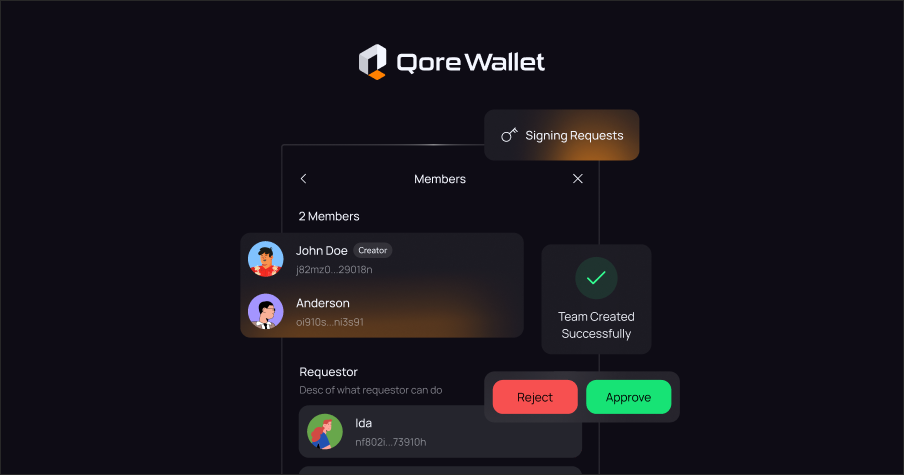
QoreWallet_ replaces single-person wallet control with team-based MPC security — roles, permissions, approval thresholds, and mobile-native access, all without sacrificing speed. No single person holds the keys. No single point of failure._
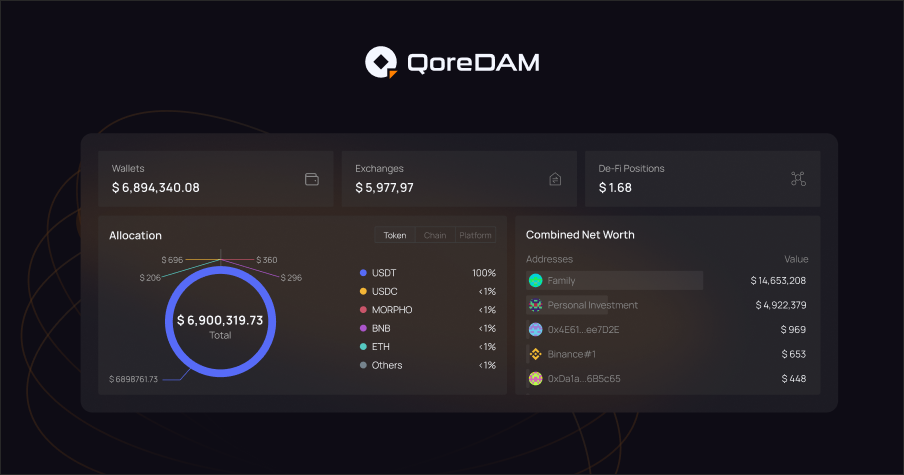
QoreDAM_ gives your team one consolidated view across every wallet, address, and chain you operate — without manual data pulls, without block explorer tabs, without reconstructing your position every time someone needs a number._
The regulatory clock is running. The GENIUS Act rules land in July. Hong Kong is issuing its first stablecoin licenses now. Institutional players are already operating at a higher standard.
The question is not whether your team needs this infrastructure. It is how much longer you can afford to operate without it.