Digital After Hours Recap: Connecting Digital Assets, Trusts & Institutional Finance at TOKEN2049
Digital After Hours Recap: Connecting Digital Assets, Trusts & Institutional Finance at TOKEN2049
Summary
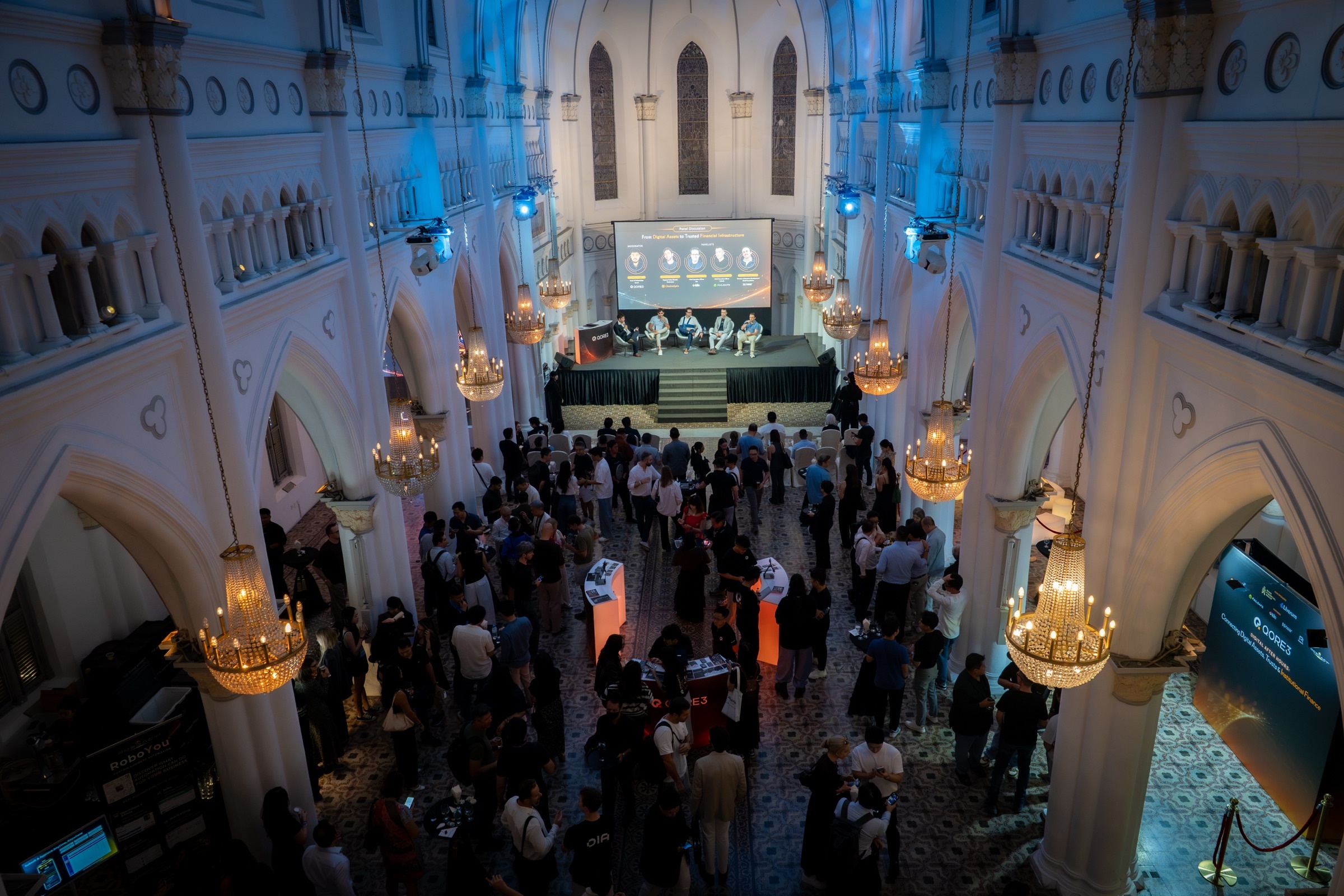
On 5 October 2026, in the middle of TOKEN2049 Week, Qore3 hosted Digital After Hours: Connecting Digital Assets, Trusts & Institutional Finance at CHIJMES Hall in Singapore, co-hosted with Chainalysis APAC and Kiln.
The evening brought together the people who build, secure and invest in digital assets, alongside the trust and fiduciary firms that institutional money increasingly runs through. Here's what happened:
- A panel on institutional trust Qore3, Chainalysis, Kiln, FailSafe and NEAR Foundation on what it takes to earn and keep institutional trust as capital moves on-chain.
- An MOU with Bhutan's GCIT Qore3 formalised its partnership with Gyalpozhing College of Information Technology, starting with a blockchain project in a Himalayan village.
- Partners on stage Introductions from Liverum and RoboAct, and a speech from GCIT.
- Singapore Grand Prix tickets Two lucky draw winners took home tickets to the Formula 1 race the following Sunday.
Why we hosted Digital After Hours
TOKEN2049 Week fills Singapore with events. Most of them are loud, and most of the conversations stay on the surface.
We wanted a room where a fund operator, a compliance lead, a trustee and a protocol team could actually talk to each other.
The reason is simple. Institutions don't adopt digital assets because the technology is new. They adopt them when the controls, the oversight and the accountability look like something they already trust.
That's the gap the event's title points at. Digital assets, trusts and institutional finance still mostly sit in separate worlds, with separate vocabularies. Getting them into one room is a small but real step toward closing it.
The venue: CHIJMES Hall
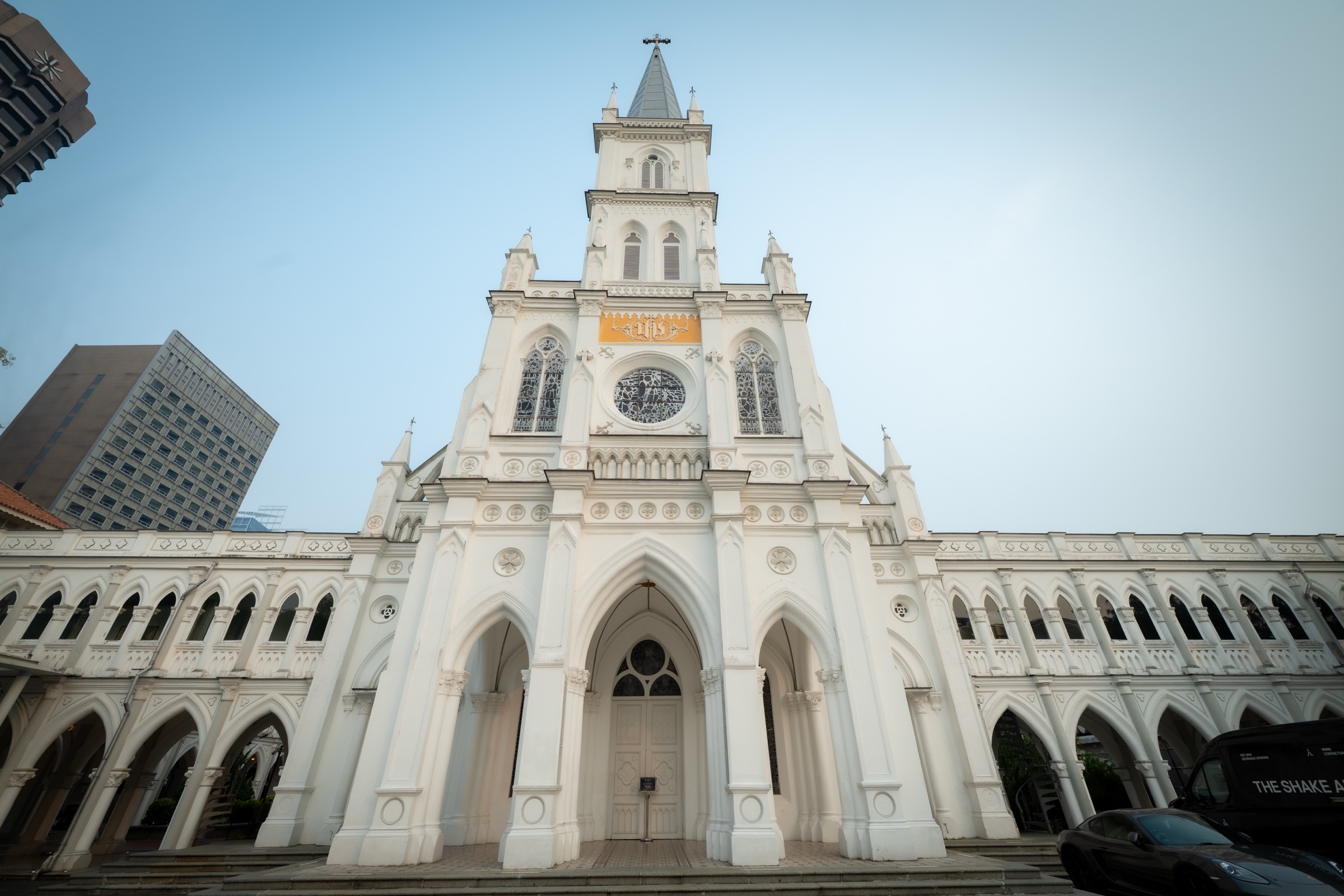
We held the evening at CHIJMES Hall, the restored Gothic chapel of the former Convent of the Holy Infant Jesus on Victoria Street in central Singapore.
CHIJMES Hall, Singapore.
Guests arrived from 6pm for a cocktail reception under the chapel's chandeliers and stained glass before the programme moved to the stage.
Partners on the night
Digital After Hours was made possible by our main sponsors, Bond Financial Group and Liverum, and our partners Chainalysis, FailSafe, Kiln, NEAR, Railnet and RoboAct.
Bond Financial Group, a Hong Kong-based group serving high-net-worth individuals, family offices and professional clients across Asia, joined Liverum as a main sponsor. It was a fitting pairing for an evening about where trusts and digital assets meet.
After the welcome address, two partners took the stage:
Liverum, a Hong Kong-based trust and fiduciary services provider, offering trust administration and wealth structuring for both traditional and digital assets.
RoboAct, a Singapore-based AI and automation company building AI, RPA and custom automation solutions.
An MOU with GCIT in Bhutan
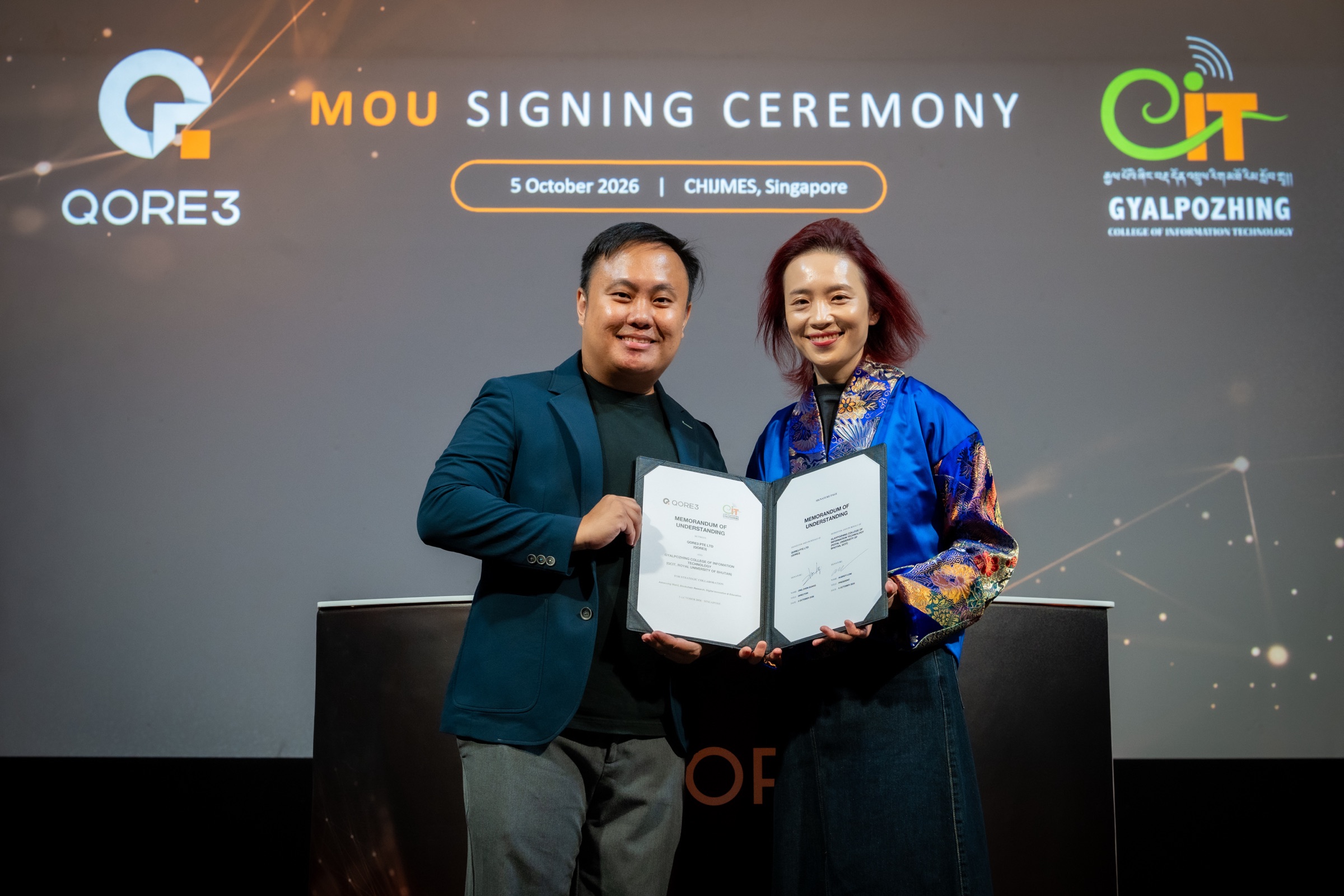
A highlight of the evening came when Ong Zhen Guang, Director of Qore3, and Dr Audrey Low, President of Gyalpozhing College of Information Technology (GCIT), signed a Memorandum of Understanding on stage. GCIT is a college of the Royal University of Bhutan and the country's leading institute for IT and digital innovation.
Ong Zhen Guang (Qore3) and Dr Audrey Low (GCIT) at the MOU signing ceremony.
The MOU formalises a relationship that began in early 2025 with work on capacity development, curriculum design and talent recruitment, including our Tokenisation, RWA & Blockchain-DeFi Workshop at GCIT. Together, we aim to:
- Strengthen digital capabilities in Bhutan
- Bridge academia and industry
- Support future-ready skills and research in digital assets and decentralised systems
- Create internship and graduate pathways where applicable
Project Digital Village in Rukha
The first joint initiative under the MOU takes blockchain somewhere it rarely goes: Rukha Village, in Bhutan's Wangdue Phodrang district.
Project Digital Village will work with 21 households in Rukha to provide MPC wallet solutions, explore a utility token-based model for community finance, and pilot AI-assisted digital wallets.
Rukha was chosen for a reason. It is where the Tarayana Foundation, founded in 2003 by Her Majesty Queen Mother Ashi Dorji Wangmo Wangchuck, began its integrated community development programme, which has since reached more than 150 villages across Bhutan. Tarayana joins the project as a partner, along with Switzerland's Lucerne University of Applied Sciences and Arts.
The groundwork is already under way. In August 2026, GCIT and Tarayana researchers visited Rukha to study household needs and existing practices. That same month, Jeffrey Cheong, Qore3's Head of Partnerships, led a workshop at GCIT on multi-agent AI development for faculty and students.
For Zhen Guang, the project tests whether the industry can build for people it usually doesn't. Most digital asset infrastructure is designed for institutions in financial centres. Building for a village means keeping the technology simple and the controls clear, and earning trust one household at a time.
For Dr Low, the goal is to make complex blockchain and digital asset concepts easier to understand, and to put technology education and digital inclusion within everyone's reach.
You can read the full announcement on Business Insider and CoinTrust.
The panel: From Digital Assets to Trusted Financial Infrastructure
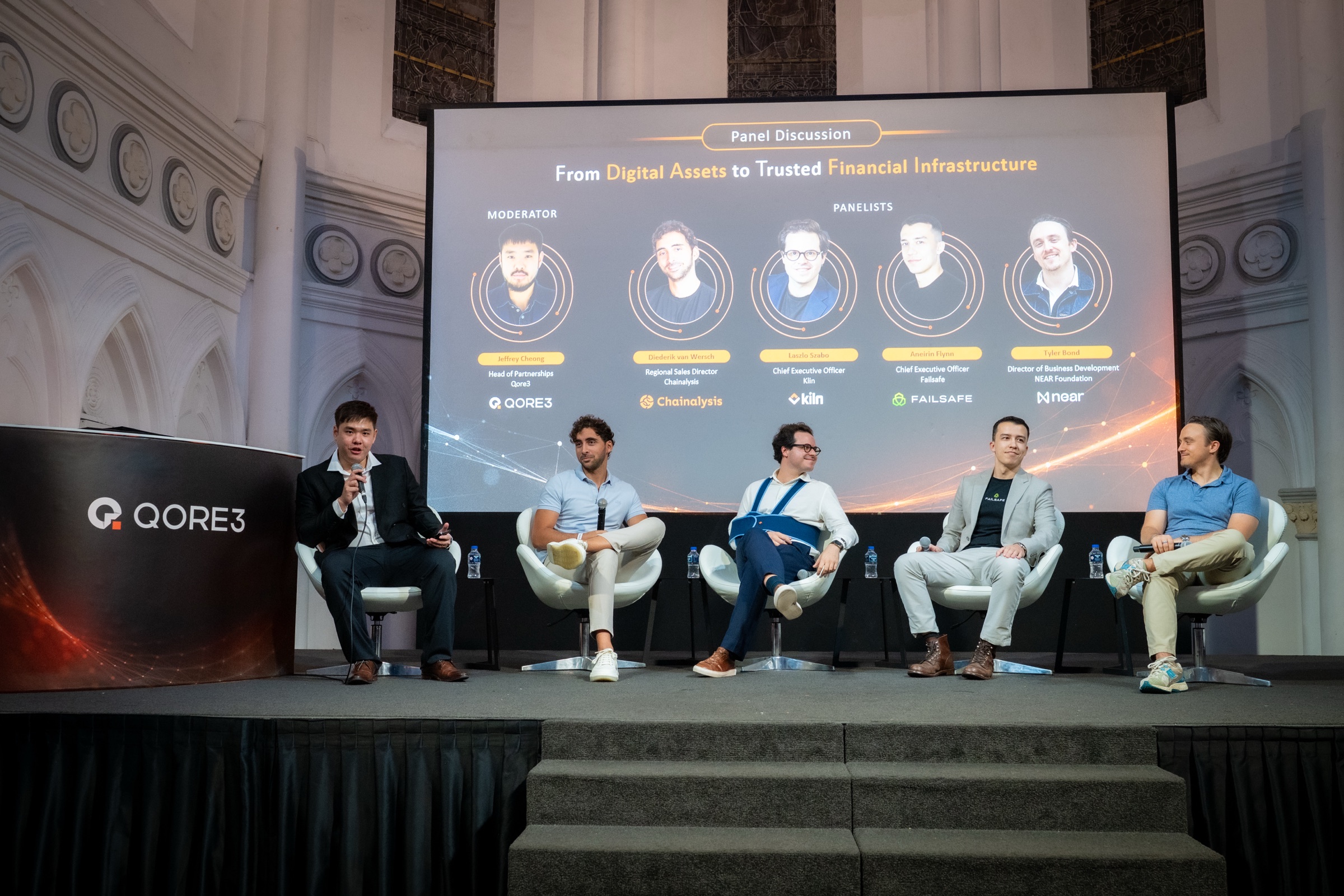
Moderated by Jeffrey Cheong, Head of Partnerships at Qore3, the panel asked one question from four angles: what does it take to earn, and keep, institutional trust as capital moves on-chain?
From left: Jeffrey Cheong (Qore3), Diederik van Wersch (Chainalysis), Laszlo Szabo (Kiln), Aneirin Flynn (FailSafe) and Tyler Bond (NEAR Foundation).
Diederik van Wersch, Regional Sales Director, Chainalysis
Laszlo Szabo, Chief Executive Officer, Kiln
Aneirin Flynn, Chief Executive Officer, FailSafe
Tyler Bond, Director of Business Development, NEAR Foundation
Between them, the panellists covered compliance, staking infrastructure, security and ecosystem development: four areas an institution has to get comfortable with before it moves meaningful capital on-chain.
Jeffrey opened with an uncomfortable fact. Most of the billions the industry has lost to exploits over the past two years were lost by companies that had already passed an audit.
It's a point we keep coming back to at Qore3. An audit is a snapshot. Trust is operational. It lives in who can move funds, under what policy, with what visibility, and whether you can prove all of it afterwards.
If you're working through those questions for your own team, our guide on how to manage crypto as a team breaks down custody, approvals, visibility and audit readiness in practical terms. For the policy side, see MPC Wallets for Teams: Policy-First Control for Real-World Web3 Ops.
The panel closed with an audience Q&A, and we'll share more takeaways from the discussion soon.
Lucky draw: Singapore Grand Prix tickets
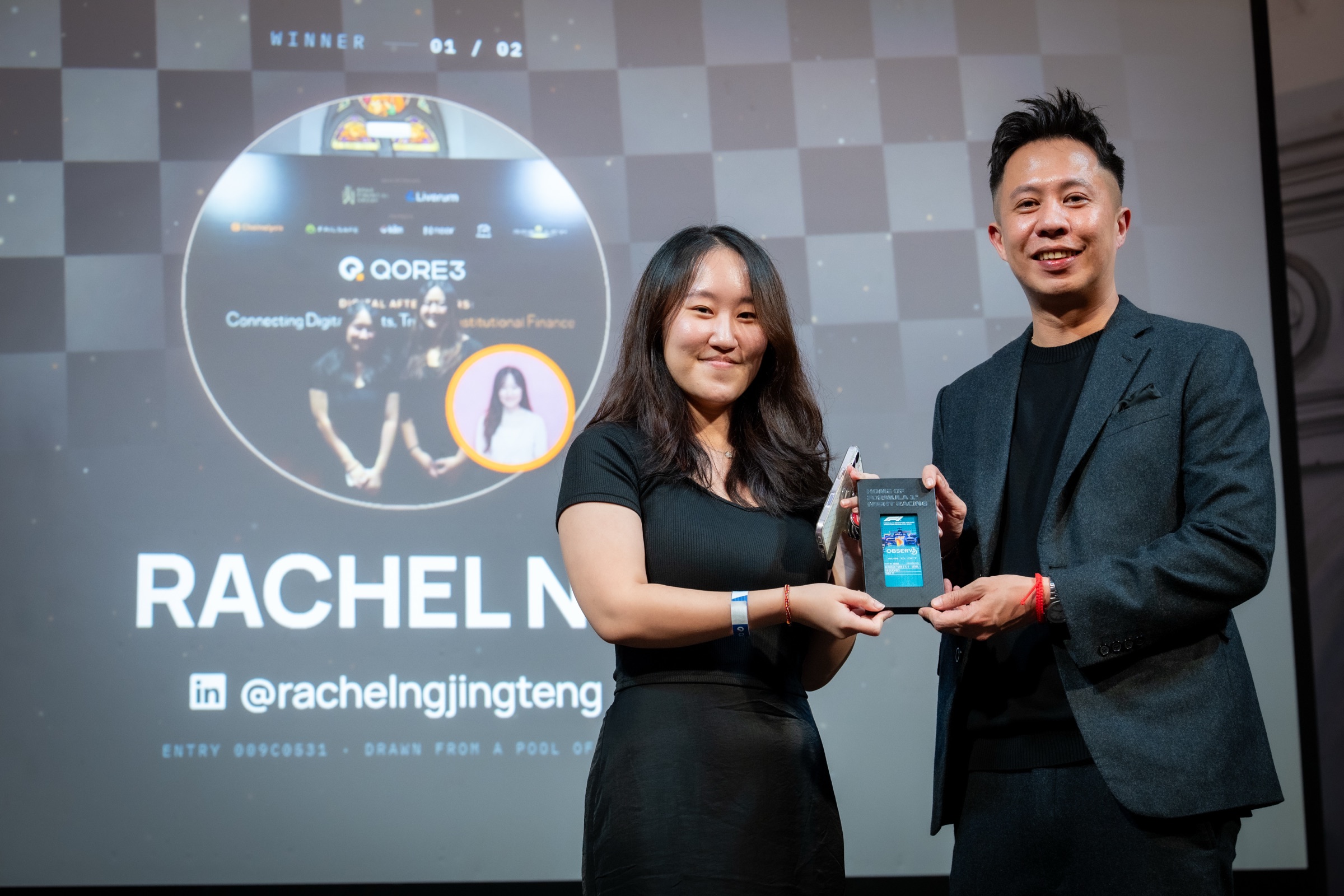
To round off the programme, we drew two winners for tickets to the Formula 1 Singapore Airlines Singapore Grand Prix 2026 on Sunday, 11 October.
One of our two lucky draw winners, with tickets to the Formula 1 Singapore Airlines Singapore Grand Prix 2026.
Congratulations to both winners. We hope the race lived up to the build-up.
Thank you
Digital After Hours came together because of the people in the room. Thank you to our co-hosts Chainalysis APAC and Kiln, our panellists, GCIT and Dr Audrey Low, our sponsors and partners, and every guest who spent a TOKEN2049 evening with us.
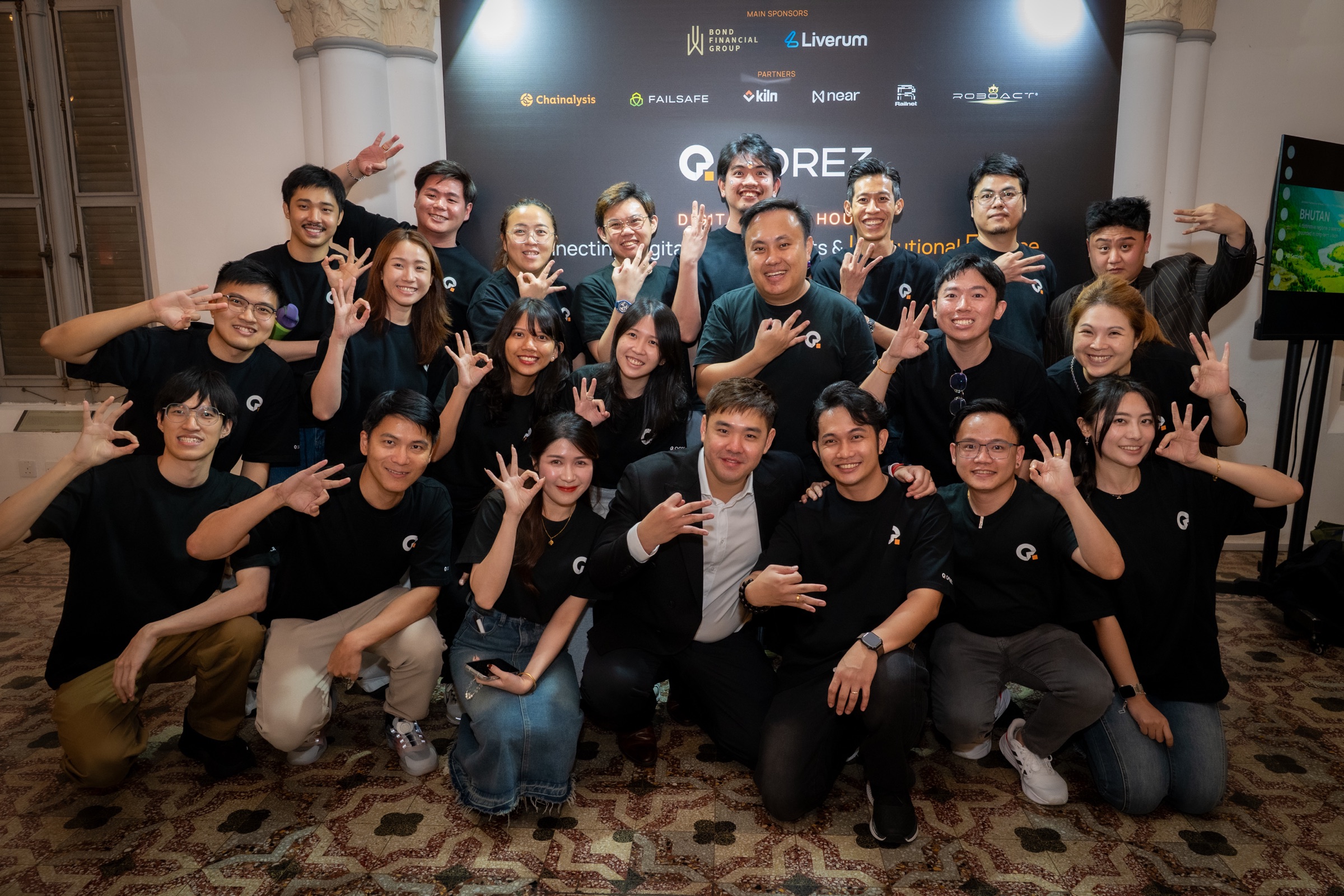
And thank you to the Qore3 team, who made the night run.
The Qore3 team at Digital After Hours.
What comes next
The MOU is a starting point. We'll share updates as Project Digital Village moves from fieldwork to pilots in Rukha, along with more from the panel.
If you're an institution, fund or fintech working out how to hold and operate digital assets with the controls your stakeholders expect, we'd like to hear from you.